The website a Malaysian private clinic needs to win patient trust (and stay within MMC advertising rules)
A practical guide for GPs, dental, aesthetic and specialist clinics in Malaysia: the pages that build patient trust and book appointments, and the Malaysian Medical Council advertising limits you must respect.
Malaysian private clinics operate under some of the strictest medical advertising rules in the region. Most clinic websites either ignore them entirely or are so cautious they fail to convert a single patient. What the Malaysian Medical Council actually permits is more than enough to build a website that ranks, earns trust, and fills appointment slots. Here is what works, what is banned, and how to stay on the right side of the rules.
By Dan Duar, Director, DNE Group. Builds websites for Malaysian SMEs through Wiz Studio Labs. Not a lawyer or a doctor; run any specific copy past your own legal adviser before publishing.
Last updated: 11 June 2026.
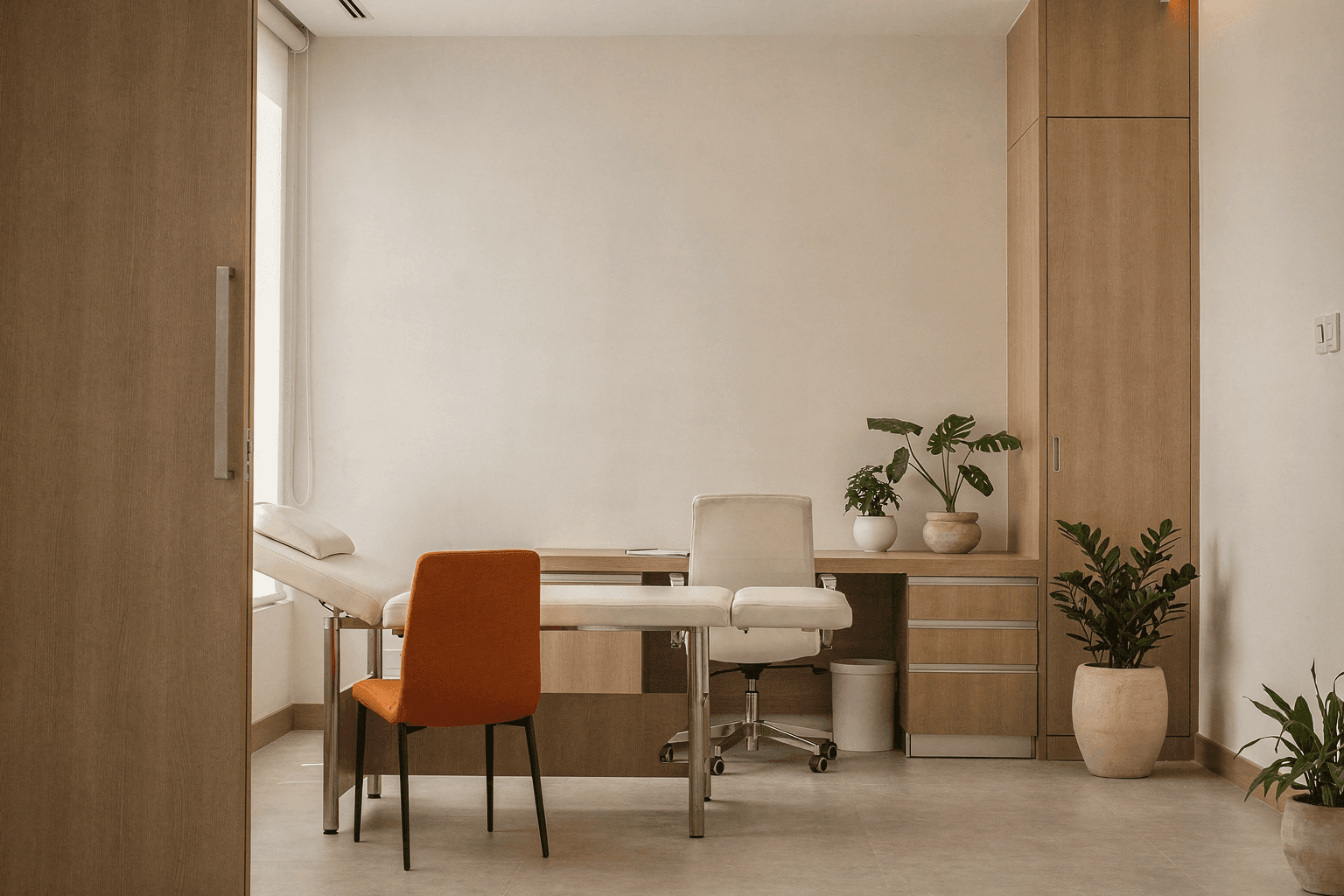
Above: a calm, well-designed Malaysian private clinic consultation room. To most patients searching online, your website is the clinic before they ever walk in.
What can a Malaysian clinic legally say on its website?
A registered private clinic's website may display the doctor's name, photograph, qualifications, MMC registration number, specialty, clinic address, contact details, operating hours, and factual descriptions of the services offered. Educational health content explaining conditions, treatments, and procedures in plain language is also clearly permitted, provided it is accurate and evidence-based.
The governing rules come from three documents: the MMC Code of Professional Conduct 2019 (CPC), MMC Guideline V2/2025 on the Dissemination of Information by Medical Professionals Including on Social Media (endorsed 19 August 2025 and available at mmc.gov.my), and the Medicine (Advertisement and Sale) Act 1956 (Act 290). All primary MMC documents are indexed at mmc.gov.my/laws-regulations.
The MMC's advertising rules sum up the permitted standard in a single phrase: any information a doctor publishes must be "informative and simple, without laudatory remarks." That phrase is the line a clinic cannot cross.
What is banned on a Malaysian clinic website?
The MMC Code of Professional Conduct 2019 prohibits registered medical practitioners from advertising to solicit patients or to promote their own professional advantage, and the MMC's 2025 guideline on the dissemination of information by medical professionals extends the same principle explicitly to websites, social media, and other online platforms. The Medicine (Advertisement and Sale) Act 1956 reinforces these prohibitions and extends them to all internet-accessible content.
The specific restrictions that matter most for a clinic website:
- Patient testimonials and endorsements: a curated "what patients say" wall reads as solicitation and self-promotion, which the MMC rules treat as a breach. The compliant alternative is genuine, patient-written Google reviews you neither edit nor cherry-pick. The Medical Protection Society Malaysia practice-promotion factsheet is a useful plain-language summary for practitioners.
- Before-and-after patient photographs: under the MMC Code of Professional Conduct 2019, identifying patient photographs must not be used without the patient's written consent, and editing an image to suggest a better outcome is a breach in its own right (a practitioner has been disciplined for exactly this). In practice, treating before-and-after photos as off-limits is the safest line for aesthetic, dental, and dermatology clinics, because consent does not cure the separate problem of the image reading as a promotional efficacy claim.
- Self-aggrandising or superlative claims: the MMC Code forbids practitioners from engaging in self-promotion such as claiming to be the "best doctor in town," "most experienced," or "most skilled." A headline like "#1 aesthetic clinic in KL" is squarely outside the rules.
- Comparative claims about other clinics or doctors: restricted under the Private Healthcare Facilities and Services Act 1998 (Act 586) and the Advertising Guidelines for Healthcare Facilities and Services (MAB 3/2023).
- Promises of guaranteed outcomes or "complete cure" language: prohibited by both the MMC Code and the Medicine (Advertisement and Sale) Act 1956.
The Medicine (Advertisement and Sale) Act 1956 (Act 290) schedules a list of serious diseases where advertising that a product or service can treat, prevent, cure, or diagnose them is a criminal offence under Section 3. The list includes conditions such as cancer, diabetes, hypertension, heart disease, and infertility. Factual descriptions of specialist services are different from promotional claims; the distinction is precision, not avoidance.
The Medicines Advertising Board (MAB) guidelines confirm the Act applies to websites: "When advertisements are available to the general public in Malaysia through the internet, such publicity shall also conform to these Guidelines."
Does a Malaysian clinic website need Medicines Advertising Board (MAB) approval?
For pages that promote specific medications or make therapeutic claims about treatments, MAB prior approval and a displayed KKLIU number are required under the Medicine (Advertisement and Sale) Act 1956. The MAB is administered by the Pharmaceutical Services Division of the Ministry of Health. A clinic website that describes services factually, without making efficacy or outcome claims, sits in clearly safer territory.
Any page that crosses into drug or treatment promotion, such as advertising a specific medication or supplement with efficacy language, should go through MAB approval before publishing. Such pages must display a KKLIU approval number (format: KKLIU XXXX/YYYY) alongside the mandatory statement: "This is a medicine advertisement." When uncertain about any specific page, get your legal adviser involved before the site goes live.
How do patients actually find a clinic in Malaysia?
Malaysia had 35.4 million internet users at the end of 2025, representing a 98.0% internet penetration rate, according to DataReportal's Digital 2026: Malaysia report. A 2022 peer-reviewed study in Family Practice (Oxford Academic) of 381 primary care patients at a Kuala Lumpur clinic found that 54.7% had searched for health information online in the past month, with 96.2% using Google and 80.8% using a mobile phone as their primary device (Lim HM et al., Family Practice, 2022). That study was conducted at a single clinic and the authors note it is not nationally representative, but it is the strongest published evidence for Malaysian healthcare search behaviour currently available.
The 93.0% of internet users in Malaysia who use the internet to search for goods and services (DOSM ICT Use and Access Survey 2024) do not stop at shopping. Patients search for clinics, check Google reviews, look at photos of the reception and the doctor, and then decide whether to call or book. Your Google Business Profile and mobile-first website are not optional extras; they are where first contact happens for the majority of new patients.
What trust signals actually work on a clinic website?
A 2022 peer-reviewed study of 360 Malaysian private GP clinic patients found the strongest predictor of patient trust was service delivery quality, with a path coefficient of 0.445. Exterior design had no statistically significant impact on trust (Arumugam et al., PMC9373924, Frontiers in Psychology, 2022). For a clinic website, this means real credentials, real photos of the doctor and clinic, and a clear description of what patients can expect from an appointment earn more trust than visual polish alone.
The most effective trust elements for a Malaysian clinic website, in order of impact:
- Doctor photos with full credential strings: not a headshot with just a name. The format used at major private hospitals: name, full qualification chain (e.g.
MBBS(UM), MMed(FamMed)(UKM)), specialty, languages spoken, consultation hours. The credential string is verifiable, which is the point. - MMC registration number with a MeRITS link: the MMC maintains a free public register called MeRITS (Medical Register Information and Technical System) at merits.mmc.gov.my/search. Any patient can search for a doctor by name, institution, or place of practice with no login required. Displaying the doctor's MMC number and linking to MeRITS so patients can self-verify is one of the clearest trust signals a clinic website can offer. It is not legally required on the website, but it demonstrates transparency that competitors rarely match. An example MMC number format looks like: MMC No. 12345.
- Real clinic photos: reception, consultation room, equipment. A 2025 study of 14,938 Google reviews across 53 Selangor private hospitals found the top patient complaints were service quality, communication, and waiting time (Sulaiman et al., JMIR Formative Research, 2025). Patients look to photos for confidence in the care experience.
- Google reviews badge: patient-authored Google reviews are different from testimonials you select and publish yourself. A genuine Google Business Profile rating, linked from the website, is the compliant version of social proof.
- Operating hours, including public holidays: high-intent patients searching at 10pm want to know if you open on Saturday and whether you are open on Merdeka Day.
Which pages does a Malaysian private clinic website actually need?
Every clinic website needs five core pages: a Homepage, Doctor profile pages (one per practitioner), Services pages (one per major category), a Panel insurance page, and a Contact and location page. These five pages answer the patient's four pre-visit questions (who treats me, what do they do, does my insurance cover this, how do I get there) and then make booking frictionless.
Homepage: above the fold, display the clinic name, location, type of clinic (GP, dental, aesthetic, specialist), and a primary contact action (WhatsApp button or booking link). No slogans. No stock photos of stethoscopes on white backgrounds.
Doctor profile pages: one dedicated page per doctor, not a paragraph on the About page. Full credential string, specialty, languages, consultation schedule, and a link to their MeRITS entry. This is where MMC compliance lives: factual, verified, dignified.
Services pages: one page per major service category. A 600-900 word page explaining how a procedure works, what to expect, who it is for, and what the follow-up looks like is both compliant and the single best move for search visibility. It is educational content, not advertising. For the compliance angle, this mirrors what works for other regulated professional-services websites, where a factual explainer outperforms any promotional page.
Panel insurance page: a dedicated page listing your insurers and third-party administrators (TPAs). According to the MEF (Malaysian Employers Federation) Medical Benefits Survey 2025 (reported in Malay Mail, December 2025), 95.2% of Malaysian companies offer outpatient consultation benefits, almost all delivered through panel clinic networks. Checking whether a clinic is on their panel is the most common pre-visit website interaction at GP clinics. List your panels clearly: private insurers (AIA, Prudential, Great Eastern, Allianz, Etiqa, Manulife, Tokio Marine), TPAs (IHP, MiCare, CompuMed, Medilink-Global), and SOCSO/PERKESO for workplace injury cases.
Contact and location page: full address, WhatsApp number, phone number, and a Waze deep link. Waze is the top-ranked Maps & Navigation Android app in Malaysia as of June 2026 (Similarweb app rankings). A Waze deep link (waze.com/ul?q=<clinic+name>&navigate=yes) removes the friction of typing an address and is a higher-intent conversion trigger than a static Google Maps embed for a Malaysian patient who defaults to Waze for daily navigation.
The structure above is what Wiz Studio Labs builds for every clinic client. If you want to see what each of these five pages looks like in practice, the Wiz clinic template has all five pre-built and ready to customise with your doctor profiles and panel list.
How should a Malaysian clinic handle appointment booking on its website?
The most effective booking setup for a Malaysian clinic combines a WhatsApp pre-filled message link as the primary path with an optional structured booking widget as secondary. This combination covers both the friction-averse mobile patient and the patient who prefers a confirmed time slot with zero phone-tag.
Columbia Asia Hospital runs a live WhatsApp appointment booking system: patients click, a pre-filled message opens in WhatsApp, and the clinic's dedicated appointments number responds. No login, no form, no friction. For clinics that want structured bookings, SaaS platforms including Kumo and Lamanify offer integrated booking widgets. Kumo reported adoption across 2,500+ clinics in Malaysia, Indonesia, and Thailand as of February 2026 (Publict.io, February 2026).
The direction from MOH is unambiguous. Dr Maheshwara Rao Appannan, Director of MOH's Digital Health Division, cited a 47.6% projected annual growth rate in Malaysia's digital health sector (CodeBlue, November 2024). Clinics that make digital booking easy are not ahead of their patients; they are meeting them where they already are.
What are the specific rules for aesthetic clinic websites in Malaysia?
Aesthetic clinics face an additional regulatory layer beyond the standard MMC Code, and it is a material one. Only MMC-registered medical practitioners holding a valid Letter of Credentialing and Privileging (LCP) from MOH may legally perform aesthetic medical procedures in Malaysia. Aesthetic medicine is not a recognised medical specialty under Malaysian law (MMC Aesthetic Guidelines 2015), and the LCP system creates three chapters of permitted procedures, tiered by the practitioner's qualifications.
For clinic websites, two rules are especially important. First, external signboards cannot carry the words "aesthetic medicine practitioner" or any aesthetic-related wording under the MMC Aesthetic Guidelines, and this spirit extends to website headers that claim credentials beyond the doctor's actual LCP chapter. Second, the MOH has published a list of three outright banned procedures: breast filler (injection-based), buttock filler (injection-based), and IV drip Vitamin C marketed for skin whitening (MOH Medical Practice Division). Advertising any of these, even by implication, is a breach of the Medical Act 1971.
Enforcement has become materially more serious. In a 2024 High Court case, an aesthetic physician was ordered to pay roughly RM 421,770 in damages and costs after carrying out a procedure outside the scope he was licensed for and failing to disclose those limitations to the patient (summarised by MahWengKwai & Associates). The broader aesthetic-medicine regulatory landscape, including the consequences of operating outside a licensed scope, is set out in this RDS Law Partners analysis. A website that implies capabilities beyond the doctor's LCP chapter, or markets banned procedures, is not a minor compliance gap.
Should a Malaysian clinic website be multilingual?
For clinics in Chinese-majority catchment areas, a Mandarin-language version of the key pages makes a material difference to conversion and to search visibility. Ethnic Chinese represent 22.4% of Malaysian citizens, roughly 1 in 5 Malaysians, according to DOSM Current Population Estimates 2024. That means a patient searching in Mandarin may never find your clinic if your site only ranks for English and Malay terms. For a GP in Klang Valley's Chinese-majority suburbs, that proportion is often higher in the actual catchment.
A study by CSA Research across 8,709 consumers in 29 countries found that 76% prefer purchasing products or services in their native language and 40% will never buy from a website in another language. At minimum, GP clinics should offer Bahasa Malaysia and English. Clinics in Chinese-majority areas should add Mandarin. Columbia Asia Hospital already offers its WhatsApp booking system in English, BM, and Chinese.
What should a Malaysian clinic website include at minimum?
A compliant, conversion-ready Malaysian clinic website needs the five pages described above, schema.org structured data using the MedicalClinic and Physician types, a sticky WhatsApp CTA on mobile, a Waze deep link, and a doctor profile that includes the MMC registration number. These are the non-negotiables. Everything else is a layer on top.
A note on specialist clinics: specialists registered with the National Specialist Register (nsr.org.my) carry an additional credential tier beyond the standard MMC registration. A specialist clinic website should display both the MMC number and the specialist qualification, link to the NSR entry where available, and make clear which conditions fall within the specialist's registered scope. Referral pathways (whether the clinic accepts walk-in or referral-only) also belong on the contact page since many specialist patients arrive via GP referral letter.
Every clinic site built by Wiz Studio Labs ships with all five pages, real doctor profile structure, a panel insurance page, a WhatsApp booking CTA, a Waze deep link, and the MedicalClinic and Physician structured data baked in. Wiring the MMC registration number into structured data alongside the human-readable page is a zero-extra-cost E-E-A-T signal that consistently earns AI citations for queries like "registered cardiologist in Klang" or "panel clinic near Subang."
We do not write clinical content or decide what to claim about your services. You and your own legal adviser own that. What we build is the architecture that makes compliant content perform.
Wiz has built 30+ websites for Malaysian SMEs (see the Wiz Index benchmark) and each clinic site follows the same five-page structure, structured data, and conversion architecture described above.
RM 399/year, two-day turnaround, pay only if you keep it. See our templates or start a brief.
Sources
- MMC Code of Professional Conduct 2019: mmc.gov.my/wp-content/uploads/2022/04/Code-of-Professional-Conduct-2019.pdf
- MMC Guideline V2/2025 on Dissemination of Information by Medical Professionals Including on Social Media: mmc.gov.my/wp-content/uploads/2025/09/The-Dissemination-of-Information-by-Medical-Profesionals-Including-on-Social-Media.pdf
- MMC Aesthetic Guidelines 2015: mmc.gov.my/wp-content/uploads/2019/11/MMC-Aesthetic-Guidelines-2015.pdf
- Medicine (Advertisement and Sale) Act 1956 (Act 290): pharmacy.moh.gov.my/sites/default/files/document-upload/medicine-advertisement-sale-act-1956-act-290_1.pdf
- MAB Advertising Guidelines for Healthcare Facilities (MAB 3/2023): pharmacy.moh.gov.my/sites/default/files/document-upload/advertising-guidelines-healthcare-facilities-and-services-mab-3.2023.pdf
- MAB Guidelines index: pharmacy.moh.gov.my/en/documents/medicine-advertisements-board-mab-guidelines-and-policy.html
- Private Healthcare Facilities and Services Act 1998 (Act 586): moh.gov.my/index.php/database_stores/attach_download/317/27
- MOH banned procedures list: hq.moh.gov.my/medicalprac/illegal-procedures/
- Medical Protection Society Malaysia, Practice Promotion factsheet: medicalprotection.org/malaysia/casebook-resources/factsheets/factsheets/mal-practice-promotion
- MMC MeRITS public doctor register: merits.mmc.gov.my/search
- DataReportal, Digital 2026: Malaysia: datareportal.com/reports/digital-2026-malaysia
- DOSM ICT Use and Access Survey 2024: dosm.gov.my/portal-main/release-content/ict-use-and-access-by-individuals-and-households-survey-report-2024
- Lim HM et al., Health information seeking among patients in a Malaysian primary care clinic, Family Practice (Oxford Academic), 2022: academic.oup.com/fampra/article/39/1/38/6356361
- Arumugam et al., Trust in Malaysian private GP clinics, PMC9373924, Frontiers in Psychology, 2022: pmc.ncbi.nlm.nih.gov/articles/PMC9373924/
- Sulaiman et al., Google review analysis of Selangor private hospitals, JMIR Formative Research, 2025: pmc.ncbi.nlm.nih.gov/articles/PMC12254706/
- MEF Medical Benefits Survey 2025: mef.org.my/Neden/news/MEF-Medical-Benefits-Survey-2025/ (reported in Malay Mail, December 2025: malaymail.com/news/malaysia/2025/12/05/two-thirds-of-employers-bracing-for-medical-premium-surge-in-2026-mef-survey-shows/200876)
- Similarweb Malaysia app rankings, June 2026: similarweb.com/top-apps/google/malaysia/maps-navigation/
- CodeBlue, MOH Digital Health Director, 47.6% growth projection: codeblue.galencentre.org/2024/11/health-sector-hungry-for-digital-front-door-moh-official/
- Kumo clinic platform regional adoption, February 2026: publict.io/2026/02/10/malaysia-based-kumo-sees-regional-clinic-adoption-as-southeast-asia-pushes-healthcare-digitalisation/
- RDS Law Partners, Aesthetic Medicine Legal Framework: rdslawpartners.com/post/aesthetic-medicine-in-malaysia-navigating-the-legal-regulatory-framework
- Malay Mail, MOH enforcement on beauty centres, January 2025: malaymail.com/news/malaysia/2025/01/14/health-ministry-says-acting-against-beauty-centres-offering-surgery-invasive-treatments/163148
- CSA Research language preference study, n=8,709, 29 countries: newswire.com/news/survey-of-8-709-consumers-in-29-countries-finds-that-76-prefer-21174283
- DOSM Current Population Estimates 2024: dosm.gov.my/portal-main/release-content/current-population-estimates-2024
Common questions
Frequently asked questions
- Can a Malaysian clinic publish patient testimonials on its website?
- It is best avoided. A curated wall of patient testimonials reads as solicitation and self-promotion, which the MMC Code of Professional Conduct 2019 treats as a breach of professional conduct. The compliant alternative is a Google Business Profile with genuine patient-authored reviews, which patients write independently as a third-party platform signal.
- Can a Malaysian clinic display before-and-after photos?
- Treat them as off-limits. Under the MMC Code of Professional Conduct 2019, identifying patient photographs must not be used without the patient's written consent, and editing an image to suggest a better outcome is a breach in its own right. Even with consent, before-and-after aesthetic, dental, or dermatology photos tend to read as a promotional efficacy claim, so the safe position is not to publish them.
- Does a Malaysian clinic need MAB approval for its website?
- For pages that constitute a medicine advertisement, promoting specific treatments, drugs, or procedures with therapeutic language, yes: MAB prior approval and a displayed KKLIU number are required under the Medicine (Advertisement and Sale) Act 1956. For factual, educational content describing clinic services without making efficacy claims, the position is less prescriptive. Get legal advice before publishing anything that makes treatment-outcome claims.
- Can a clinic say it specialises in a particular condition?
- Factually describing the areas a clinic treats is permitted. What the MMC Code of Professional Conduct 2019 forbids is self-aggrandising language, such as claiming to be the best, most experienced, or most skilled. A page explaining what a specialty covers, how it is treated, and what qualifications the doctor holds is compliant. A headline claiming '#1 aesthetic clinic in KL' is not.
- How can a patient verify a doctor's registration in Malaysia?
- The MMC's public MeRITS register (Medical Register Information and Technical System) at merits.mmc.gov.my/search allows anyone to search for a registered medical practitioner by name, institution, or place of practice with no login required. For specialists, the National Specialist Register at nsr.org.my supplements MeRITS with additional specialist credential verification.
- What schema markup should a Malaysian clinic use?
- Use MedicalClinic (for the facility) and Physician (for each doctor, with medicalSpecialty and alumniOf properties) from schema.org. Add FAQPage for the patient FAQ section, LocalBusiness contact details, and BreadcrumbList for navigation. These help Google and AI engines understand the structure of the clinic's information and cite it accurately in answer-engine responses.
About the author

Dan Duar
Founder, Wiz Studio Labs · Director, DNE Forwarding
Writes The Wiz Journal on websites, SEO, and digital growth for Malaysian SME owners. Previously a senior data analyst at Grab and a tech consultant at EY. BNI Integrity Shah Alam member.
Like what you read
Get a Wiz site for RM 399/year.
We build it free in 2-3 days. You see it live before you spend a ringgit. Keep it if it works for your business.
No card · No sales call