E-commerce store vs landing page: what your Malaysian SME actually needs
Do you need a full online store or just a simple landing page? Here is the honest decision framework for Malaysian SMEs, with real costs (Shopify, WooCommerce, Shopee, Lazada) and how Malaysians actually pay.
Most Malaysian SMEs do not need a full e-commerce store. You need one only if you sell many products by self-checkout and ship them out. If you sell services, a few items, or close by conversation, a landing page that informs and captures the enquiry (then collects by WhatsApp, DuitNow QR, or FPX) usually wins on cost and upkeep.
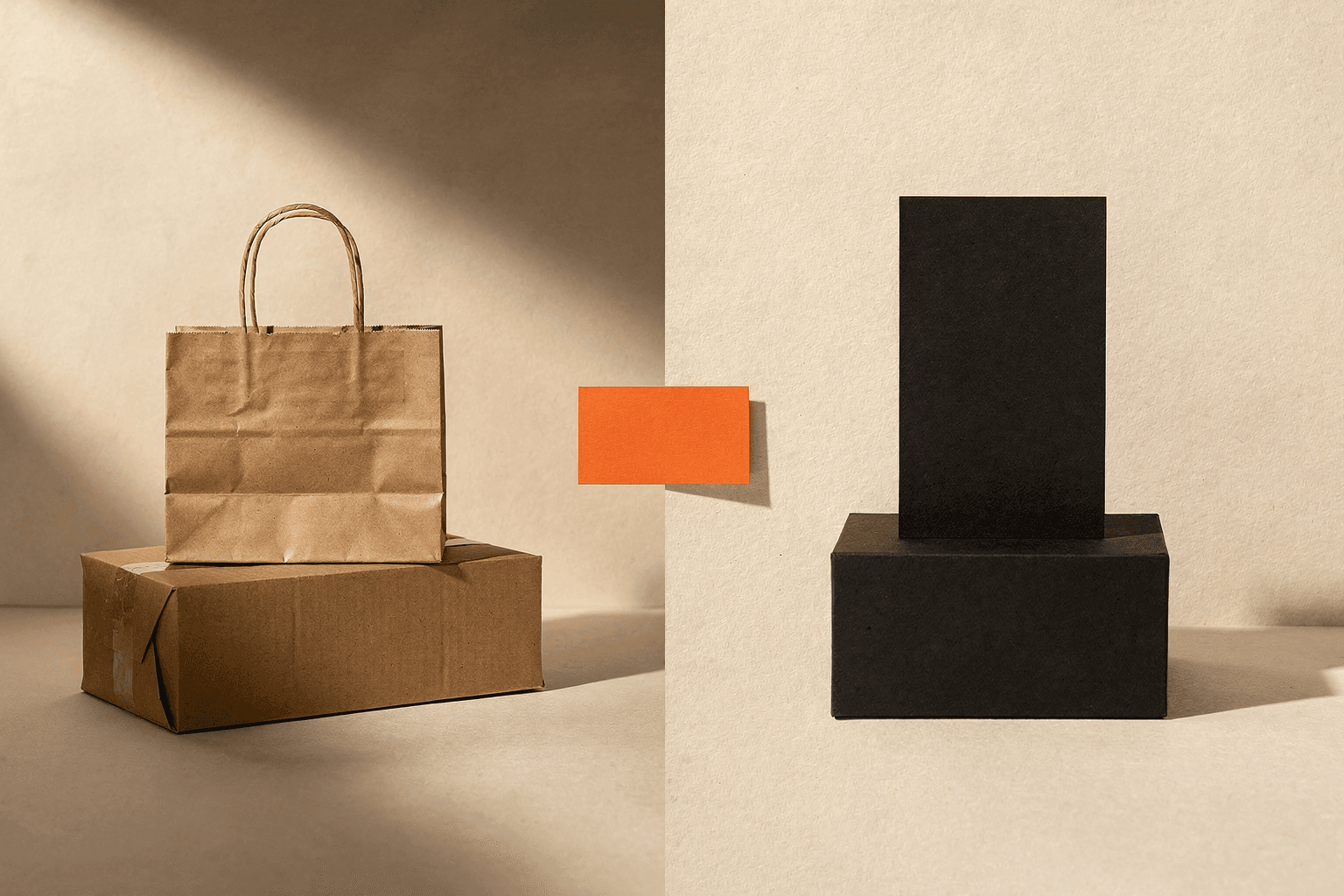
Above: a kraft shopping bag and parcel beside a single focused product card, the contrast between a full online store and a one-page site.
Published: 2026-06-11 · Last updated: 2026-06-11
What is the actual difference between an e-commerce store and a landing page?
A full e-commerce store is a self-service shop: a product catalogue, a cart, an online checkout, plus the back office that goes with it, inventory counts, shipping rules, and order management. A landing page (or brochure site) does a narrower job: it explains what you offer, builds trust, and captures the enquiry, then you close and collect payment by WhatsApp, DuitNow, FPX, or in person.
The line that matters is the checkout. An e-commerce store lets a stranger buy at 2am with no human involved. A landing page hands that stranger a fast, frictionless way to reach you. According to DataReportal's Digital 2024: Malaysia report, there were 33.59 million internet users in Malaysia at the start of 2024, at 97.4 percent internet penetration. The real question is not whether your customers are online, they are; it is whether they should be checking out by themselves, or talking to you first.
Who actually needs a full e-commerce store?
You need full e-commerce when three things are true at once: you have many products (dozens of SKUs or more), customers prefer to buy by self-checkout without speaking to you, and you ship orders, usually nationwide. A fashion label, a skincare brand, or a parts supplier with a wide catalogue fits this profile. Here the cart, inventory, and shipping logic earn their keep.
The Malaysian appetite for online buying is real and rising. Bank Negara Malaysia reported, via Bernama, that selected retail e-payment transactions reached RM698.1 billion in 2024, a 17 percent increase, while total e-payment transactions grew 28 percent to 14.7 billion. If your products move in that flow and customers want to self-serve, a store is the right tool. The cost only makes sense once volume justifies it.
Who is better off with a landing page plus WhatsApp ordering?
Most service businesses, low-SKU sellers, local trades, F&B outlets, and anyone whose sales are consultative are better served by a landing page plus WhatsApp ordering. If a customer needs a quote, a booking, or simply prefers to chat before paying, a cart adds friction without adding sales. A clinic, a contractor, a tuition centre, or a caterer sells by conversation, not by self-checkout.
The Malaysian payment context makes this work cleanly. Bank Negara Malaysia's 2024 figures show DuitNow QR transaction value more than doubling to RM31.1 billion, with 2.6 million registered acceptance points, and 64 percent of e-money transactions running through e-wallets. You do not need a built-in checkout to get paid. A WhatsApp enquiry that ends in a DuitNow QR scan or an FPX transfer settles the same money, with no monthly store fee and no transaction percentage skimmed off each sale. See our guide on lead capture versus WhatsApp for Malaysian SMEs for how to wire the enquiry path.
What is the real cost and maintenance difference?
The cost gap is large and ongoing, not a one-time difference. A hosted e-commerce platform charges a recurring subscription plus a percentage of every sale, on top of the work of keeping products, prices, stock, and shipping accurate. A simple landing page is a flat annual cost with almost nothing to maintain beyond your contact details and offers.
Here are the verifiable platform costs as of mid-2026:
- Shopify: the Basic plan is USD 25 per month, or USD 19 per month on annual billing, per Shopify's own pricing page. On top of the subscription, online card payments via Shopify Payments run at 2.9 percent plus 30 cents per transaction, and using a third-party gateway instead adds Shopify's own 2 percent transaction fee.
- WooCommerce: the core plugin is free and open-source, but multiple 2026 cost breakdowns (for example WizCommerce) put a real, maintained store at hosting plus premium themes, plugins, and payment-gateway fees, commonly hundreds of US dollars a year before a single sale.
- A landing page: a flat annual fee, no per-sale cut. Wiz Studio Labs builds and hosts a complete one-page site for a Malaysian SME at RM 399 per year, one edit included.
The hidden cost of a store is not the subscription. It is you, every week, updating stock counts and prices. For a deeper breakdown of what a site should cost, see how much a website costs in Malaysia in 2026.
How do Malaysians actually pay, and does it require an online checkout?
Malaysians pay online overwhelmingly by bank transfer and e-wallet, neither of which requires a hosted checkout. Bank Negara Malaysia's 2024 data records 14.7 billion e-payment transactions, up 28 percent, with DuitNow QR value more than doubling to RM31.1 billion and 64 percent of e-money flowing through e-wallets. A QR code or DuitNow ID collects payment with zero platform fee.
This is why a landing page works for so many Malaysian SMEs. The customer reads your page, messages you on WhatsApp, you confirm the order, and they scan a DuitNow QR or transfer by FPX. According to market data reported by Statista, account-to-account bank transfers were the single most popular e-commerce payment method in Malaysia, ahead of digital wallets. A built-in cart is a convenience for high-volume self-serve buying, not a requirement for getting paid. Our WhatsApp Business versus a website guide covers how the two work together.
What if I already sell on Shopee, Lazada, or TikTok Shop?
If marketplaces already handle your selling and shipping, you usually do not need your own store, you need a credibility site. Shopee, Lazada, and TikTok Shop already give you the cart, the payment, and the traffic, so a parallel store duplicates what you pay commission for. What they cannot give you is a branded home that ranks on Google.
Those marketplace commissions are not small. The Star reported in November 2025 that Lazada raised its Malaysian seller commission to up to 22.5 percent across five product clusters. On Shopee Malaysia, a 3.78 percent transaction fee applies to the final order amount on top of category commission, per Shopee's own Seller Education Hub. A landing page that sends interested buyers to your verified marketplace listings, while capturing direct WhatsApp enquiries that skip the commission, is often the smartest split: let the marketplace do the logistics, let your own page do the trust-building and the commission-free direct sales.
What is the decision framework: store or landing page?
Run your Malaysian business through the seven questions in the table below. If most of your answers point to the right column, a landing page is the better starting point, and you can graduate to a full e-commerce store later, only if and when self-serve volume genuinely demands it.
| Question | Lean to e-commerce store | Lean to landing page + WhatsApp |
|---|---|---|
| How many products? | Dozens or more (true catalogue) | One to a handful, or services |
| How do customers decide? | Self-serve, no conversation needed | They ask questions, want a quote |
| How is it delivered? | Shipped, often nationwide | Service, local, or in-person pickup |
| Sales style | Transactional, repeat | Consultative, relationship-led |
| Stock to track? | Yes, live inventory | Little or none |
| Who updates it weekly? | You or staff, ongoing | Almost never |
| Payment | Card checkout at 2am | DuitNow QR / FPX / WhatsApp-confirmed |
A useful rule of thumb: if explaining and capturing the enquiry is 80 percent of the job and the cart is the other 20, start with a landing page. You keep the option to add a store the day self-checkout becomes the bottleneck. For the layout itself, our homepage conversion checklist for Malaysian SMEs shows what a high-converting one-page site contains.
What is the most common and costly mistake here?
The most common and costly mistake is building a full e-commerce store you cannot keep stocked and updated. A store with out-of-date prices, items marked in-stock that you no longer carry, or a checkout that breaks at payment does more damage than no store at all, because it converts an interested buyer into a frustrated one at the exact moment they were ready to pay.
An empty or stale cart is a trust killer. With 33.59 million Malaysians online at 97.4 percent internet penetration per DataReportal, your customers will find the page; the only question is whether what they find still works. Many SMEs launch a store in a burst of enthusiasm, then let it rot because the weekly upkeep was never realistic for a small team. A landing page has almost nothing to go stale. Start with what you can maintain, and let real demand, not optimism, decide when you are ready for a full store.
How do I get the right one built for my Malaysian business?
Start with the simplest site that fully answers your customer, and add complexity only when sales demand it. For most Malaysian SMEs that means a clean, fast landing page with your services, your story, and a frictionless path to WhatsApp or DuitNow, not a store you will struggle to maintain. If you genuinely have a wide catalogue and self-serve buyers, build the store instead.
Wiz Studio Labs builds and hosts complete one-page websites for Malaysian SMEs at RM 399 per year, with one edit included and no setup fee. Pay only if you keep it. We will tell you honestly whether your business is a landing-page case or a true e-commerce case before you spend a ringgit. Start your site, or contact us to talk it through. If you also want to weigh hosting choices, see our guide to hosting a Malaysian SME website.
Sources
- DataReportal: Digital 2024: Malaysia (33.59 million internet users, 97.4% penetration, January 2024)
- Bank Negara Malaysia, via Bernama: Selected Retail E-Payment Transactions Reach RM698.1 Bln In 2024
- Shopify: Pricing plans and Credit card processing fees 2026
- WizCommerce: WooCommerce Pricing 2026: Hosting, Plugins & Real Costs
- The Star: Lazada raises seller commission rate, now charges up to 22.5% (3 November 2025)
- Shopee Malaysia Seller Education Hub: Marketplace Commission Fees
- Statista: Leading e-commerce payment methods in Malaysia
Common questions
Frequently asked questions
- Does my Malaysian small business need a full e-commerce store or just a landing page?
- Most Malaysian SMEs need a landing page, not a full store. Build e-commerce only when you have many products (dozens of SKUs), customers buy by self-checkout without speaking to you, and you ship orders out. If you sell services, a few items, or close deals by conversation, a landing page that captures the enquiry and collects payment by WhatsApp, DuitNow QR, or FPX is cheaper and far easier to maintain.
- How much does an online store cost compared to a landing page in Malaysia?
- A hosted store carries a recurring subscription plus a per-sale cut. Shopify's Basic plan is USD 25 per month (USD 19 on annual billing) plus card fees of 2.9 percent plus 30 cents per online sale, per Shopify. WooCommerce is free to install but real hosting, plugins, and gateway fees add up. A landing page is a flat annual cost: Wiz Studio Labs builds and hosts one for RM 399 per year, one edit included.
- Can I take payment in Malaysia without an online checkout?
- Yes. Malaysians pay overwhelmingly by bank transfer and e-wallet. Bank Negara Malaysia recorded DuitNow QR value more than doubling to RM31.1 billion in 2024, with 64 percent of e-money flowing through e-wallets. A customer can read your landing page, message you on WhatsApp, then scan a DuitNow QR or transfer by FPX. No hosted cart, and no platform fee skimmed off each sale.
- I already sell on Shopee and Lazada. Do I still need a website?
- You do not need your own store, but a credibility site helps. Marketplaces give you the cart, payment, and traffic, but charge heavy commission: The Star reported Lazada raised Malaysian seller commission to up to 22.5 percent in November 2025, and Shopee adds a 3.78 percent transaction fee on top of category commission. A landing page builds trust, ranks on Google, and captures commission-free direct enquiries.
- What is the biggest mistake when choosing between a store and a landing page?
- Building a full e-commerce store you cannot keep stocked and updated. Stale prices, out-of-stock items still listed as available, or a checkout that breaks at payment turns an interested buyer into a frustrated one. Many SMEs launch a store on enthusiasm, then let it rot when weekly upkeep proves unrealistic for a small team. Start with what you can maintain, and let real demand decide when you are ready for a store.
About the author

Dan Duar
Founder, Wiz Studio Labs · Director, DNE Forwarding
Writes The Wiz Journal on websites, SEO, and digital growth for Malaysian SME owners. Previously a senior data analyst at Grab and a tech consultant at EY. BNI Integrity Shah Alam member.
Like what you read
Get a Wiz site for RM 399/year.
We build it free in 2-3 days. You see it live before you spend a ringgit. Keep it if it works for your business.
No card · No sales call