Instagram or Facebook page vs a website: what Malaysian SMEs need
Running your whole business off an Instagram or Facebook page in Malaysia? Here is the honest answer on social pages versus a website, why social is rented land, and what most SMEs should actually do.
The honest answer for a Malaysian business is that you need both, not one or the other. Instagram and Facebook are great for discovery, reach, and personality. A website is what you actually own: it ranks in Google and AI search, holds your full information as searchable text, looks credible, and does not vanish if your account gets locked.
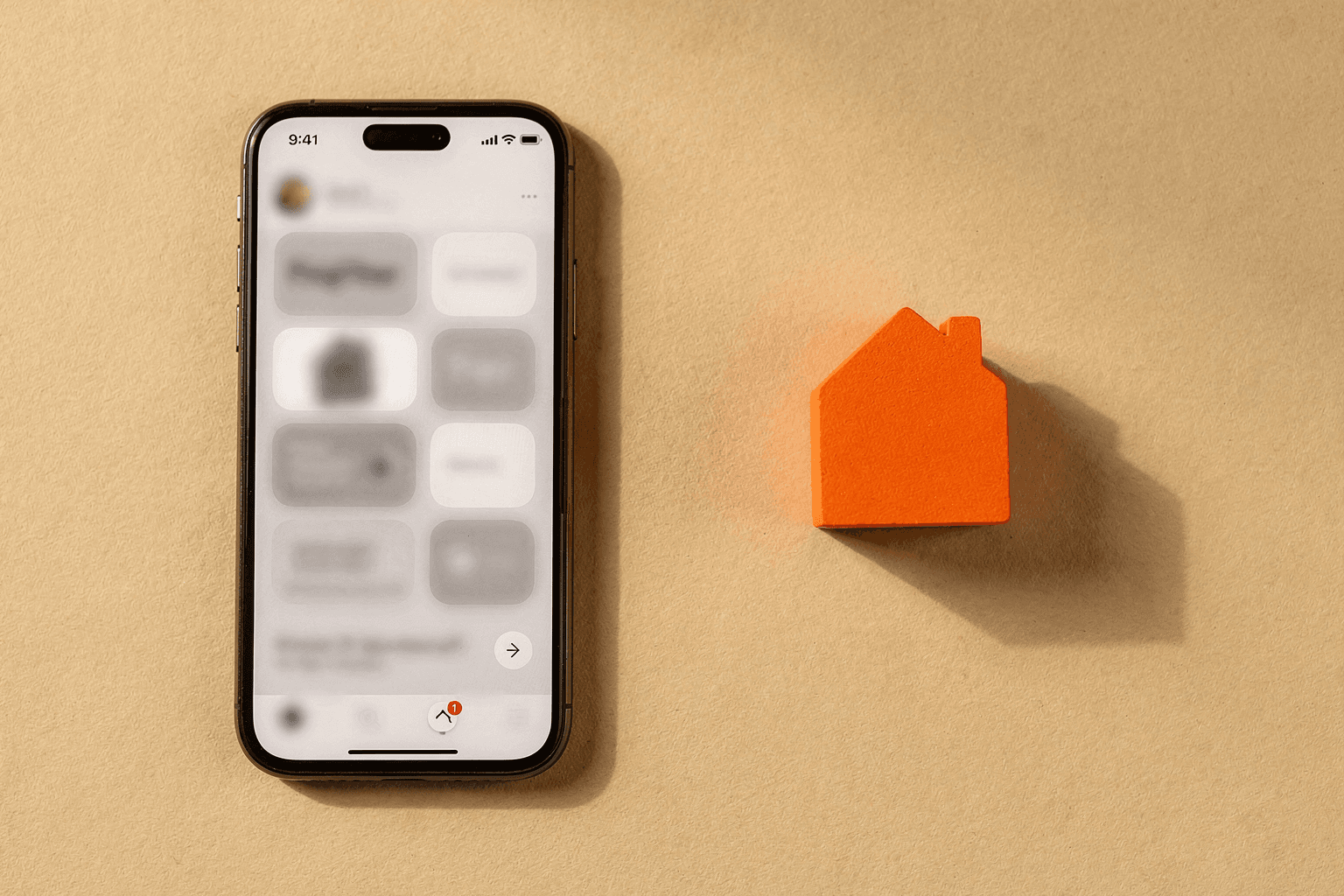
Above: a phone showing an abstract social feed on a busy surface, beside a steady, well-lit "home base" object on bone-coloured paper, lit warm with one orange accent.
Published: 2026-06-11 · Last updated: 2026-06-11
Is an Instagram or Facebook page enough to run a business in Malaysia?
For most Malaysian SMEs, a social page alone is not enough, but it is not useless either. Instagram and Facebook are where people discover you and feel your brand. A website is where they verify you, find your full details, and decide to buy. They do different jobs, so run both and connect them.
Malaysia is one of the most social-first markets on earth, which is exactly why the gap matters. According to DataReportal's Digital 2026: Malaysia report, Malaysia had 30.7 million social media user identities in October 2025, equal to 85.0 percent of the total population. With nearly everyone reachable on social, the platforms are great for the top of your funnel. The problem is what happens after someone is interested.
Why is a social media page called "rented land"?
A social page is "rented land" because you do not own the platform, the audience, or the rules. Meta owns Instagram and Facebook, and it can change how many of your followers see a post, restrict an account, or remove one entirely. You build on someone else's property, and the landlord can change the terms without asking you.
Two realities make this concrete for a Malaysian SME:
- Reach is throttled, and it has been falling for years. HubSpot's roundup of the decline in Facebook organic reach reports that Edgerank Checker measured average Page organic reach falling from about 16 percent to 6.5 percent between 2012 and 2014, while Social@Ogilvy found reach as low as 2 percent for Pages with more than 500,000 likes. Engagement is now thinner still: Socialinsider's 2026 benchmark, built from 25 million posts across 130,683 pages between January 2024 and December 2025, puts the average Facebook engagement rate at just 0.15 percent.
- Accounts get locked, sometimes by mistake. NBC News reporting on Meta account suspensions found users whose accounts were disabled by automated systems, with Meta later admitting in some cases that its technology "made a mistake." If your whole business lives on that account, a wrong flag freezes your shopfront overnight.
You did not lose anything you owned, because you never owned it. That is the cost of building only on rented land.
What can a website do that an Instagram or Facebook page cannot?
A website does five things a social page structurally cannot. It ranks in Google and AI answers, holds your full information as crawlable text, looks credible at a glance, keeps your customer data under your control, and stays online if your account is locked. A social profile is built for scrolling, not for these jobs.
Here is the split in plain terms:
| Job | Instagram / Facebook page | Your own website |
|---|---|---|
| Discovery and reach | Strong | Weak on its own |
| Ranking in Google search | No | Yes |
| Cited in AI answers (ChatGPT, Gemini) | Rarely | Yes, if structured well |
| Full menu / services as searchable text | No (captions are not indexed like a site) | Yes |
| Looks credible to a cautious buyer | Mixed | Strong |
| You own the customer relationship | No | Yes |
| Survives an account lock | No | Yes |
The search point is the big one. When a Malaysian customer types "aircon service Subang Jaya" or asks an AI assistant "who does halal catering in Shah Alam," the engines pull from indexed web pages with clear text and structured data. Your latest Reel does not enter that race. If you want more on how this is shifting, see GEO vs SEO for Malaysian SMEs.
What does Malaysia's social media usage actually look like?
Malaysians are heavy, multi-platform social users, which is why a single page feels like "enough" until you look at search. Per DataReportal's Digital 2026: Malaysia report, 35.4 million people in Malaysia were using the internet at the end of 2025, a penetration of 98.0 percent. Social reach is enormous, but it is spread across several apps, not one.
The same report shows the platform mix in late 2025:
- TikTok: reached 30.7 million users aged 18 and above, equal to 86.8 percent of internet users.
- Facebook: reached 23.0 million users, or 63.7 percent of the total population.
- Instagram: reached 16.1 million users, or 44.6 percent of the population.
- YouTube: reached 23.6 million users, or 65.4 percent of the population.
Notice the spread. Your audience is split across TikTok, Facebook, Instagram, and YouTube, and each app shows your content to a shrinking slice of your own followers. A website is the one place all of those audiences can be funnelled into, search for, and find consistently.
Why is the "link in bio" a bottleneck for Malaysian SMEs?
The "link in bio" is a bottleneck because social platforms deliberately limit where you can send people. Instagram and Facebook keep users inside their apps, so a profile gives you very little room to put your services, prices, booking, and contact details in one clickable place. Everything funnels through a single line that most viewers never tap.
In practice this means a customer who is genuinely interested has to remember to scroll to your bio, tap one link, and hope it leads somewhere useful. Many give up. A website flips that: one address (yourbusiness.com.my) that holds everything, works in any search, prints on a name card, and reads cleanly when someone shares it on WhatsApp. Speaking of which, if WhatsApp is your main channel, WhatsApp Business versus a website covers where each one fits.
The point is not to abandon the bio link. It is to make that link point to land you own, instead of to another rented page.
So what should most Malaysian SMEs actually do?
Most Malaysian SMEs should keep social for the top of the funnel and point everything to an owned website at the bottom. Use Instagram, Facebook, and TikTok to be discovered and to show personality. Use your website to be found in search, to be verified, and to convert. Treat social as the billboard and the website as the shop.
A simple operating split that works for a small team:
- Discovery on social. Post Reels, stories, and updates where your audience already scrolls. This is reach and personality.
- Verification and conversion on the website. Full services, prices or price ranges, real photos, your address, opening hours, and one clear contact action. This is trust and the sale.
- One bio link, pointing home. Every social profile's link goes to your website, not to a competitor's marketplace or a dead Linktree.
- Get found in search. Claim your Google Business Profile and make sure your website is mobile-first, because most Malaysian traffic is on a phone.
This is not expensive. The objection most owners raise is cost, and the honest answer is that a working business website in Malaysia no longer needs to cost thousands of ringgit. Here is what a website actually costs in Malaysia in 2026.
When does a website matter most for a Malaysian business?
A website matters most in three situations: when customers find you through Google or AI search, when a B2B buyer is checking whether you are credible, and when you take bookings or enquiries that need full information. In all three, a social page either does not appear or does not give the buyer enough to commit.
The clearest cases:
- Search-driven buying. If people find services like yours by typing into Google or asking an AI assistant, you need indexed web pages, not just posts. You can even handle the basics of search yourself without an agency.
- B2B and higher-value deals. A company vetting a supplier expects a real website. A profile with no site reads as small or temporary, fairly or not.
- Bookings, quotes, and enquiries. A website can hold a full service list, a quote form, opening hours, and a WhatsApp or call button in one place, with none of the scroll-and-hope of a bio link.
If social is doing all your discovery but you have no owned home for it to land on, that is the gap to close first. Wiz Studio Labs builds and hosts a complete, mobile-first business website for Malaysian SMEs at RM 399 per year, with one edit included, and you pay only if you keep it. You can start your site here and see your own pages built before deciding. Keep the social pages doing what they do well, and give them somewhere of your own to point.
Sources
Common questions
Frequently asked questions
- Is an Instagram or Facebook page enough for my Malaysian business, or do I need a website?
- You need both. Instagram and Facebook are strong for discovery and personality, but they do not rank in Google or AI search and you do not own the audience. A website ranks in search, holds your full services as text, looks credible, and survives an account lock. Keep social for reach and point everything to an owned site.
- Why do people call a social media page rented land?
- Because you do not own the platform, the audience, or the rules. Meta owns Instagram and Facebook and can throttle your reach, restrict an account, or remove one. HubSpot's roundup reports Edgerank Checker measuring Facebook Page organic reach falling from about 16 percent to 6.5 percent between 2012 and 2014, with Social@Ogilvy finding reach as low as 2 percent for Pages over 500,000 likes. You build on someone else's property.
- How many Malaysians use social media in 2026?
- According to DataReportal Digital 2026: Malaysia, Malaysia had 30.7 million social media user identities in October 2025, equal to 85.0 percent of the population, and 35.4 million internet users at 98.0 percent penetration. Reach is huge, but it is split across TikTok (86.8 percent of internet users), Facebook (63.7 percent of population) and Instagram (44.6 percent), so no single page reaches everyone.
- What does a website do that an Instagram or Facebook page cannot?
- A website ranks in Google and gets cited in AI answers, holds your full menu or services as crawlable text, looks credible to a cautious buyer, keeps your customer relationship under your control, and stays online if your social account is locked. Captions and Reels are not indexed the way web pages are, so a social profile cannot do any of these.
- How much does a simple business website cost in Malaysia?
- A working business website in Malaysia no longer costs thousands of ringgit. Wiz Studio Labs builds and hosts a complete, mobile-first website for Malaysian SMEs at RM 399 per year, with one edit included, and you pay only if you keep it. You can see your own pages built before you decide, then keep your social pages pointing to it.
- When does a website matter most for a Malaysian business?
- A website matters most when customers find you through Google or AI search, when a B2B buyer is checking that you are credible, and when you take bookings, quotes, or enquiries that need full information. In all three, a social page either does not appear in search or does not give the buyer enough detail to commit.
About the author

Dan Duar
Founder, Wiz Studio Labs · Director, DNE Forwarding
Writes The Wiz Journal on websites, SEO, and digital growth for Malaysian SME owners. Previously a senior data analyst at Grab and a tech consultant at EY. BNI Integrity Shah Alam member.
Like what you read
Get a Wiz site for RM 399/year.
We build it free in 2-3 days. You see it live before you spend a ringgit. Keep it if it works for your business.
No card · No sales call